


-
Birth name
Lucas Saner
-
Place of Birth
unknown
-
SURNAME HERITAGE
England
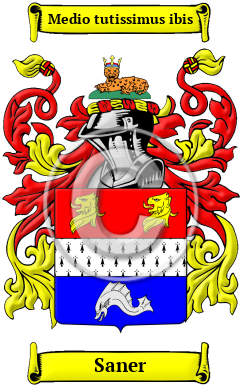
Saner History, Family Crest & Coats of Arms
Etymology of Saner
What does the name Saner mean?
The Saner family was an integral part of Britain’s Norman legacy, a legacy that began in 1066 with the Conquest of the island. Saner was a name given to a person with lordly bearing, or the older of two people with the same name. The first is by analogy with the French seigneur, meaning lord.
Early Origins of the Saner family
The surname Saner was first found in Norfolk, where the family was granted lands by William the Conqueror for having assisted at the Battle of Hastings in 1066. The earliest known bearer of the name was Walter Seignure, who was recorded in the Pipe Rolls of Norfolk in 1164.
Early History of the Saner family
This web page shows only a small excerpt of our Saner research. Another 176 words (13 lines of text) covering the years 1150, 1164, 1212, 1271, 1382, 1475, 1565, 1845 and 1887 are included under the topic Early Saner History in all our PDF Extended History products and printed products wherever possible.
Saner Spelling Variations
Anglo-Norman names are characterized by a multitude of spelling variations. When the Normans became the ruling people of England in the 11th century, they introduced a new language into a society where the main languages of Old and later Middle English had no definite spelling rules. These languages were more often spoken than written, so they blended freely with one another. Contributing to this mixing of tongues was the fact that medieval scribes spelled words according to sound, ensuring that a person’s name would appear differently in nearly every document in which it was recorded. The name has been spelled Senior, Sinyeard, Singard, Sinyard, Sinor, Sayner, Saynor, Sayner and many more.