
-
Birth name
Chaveon Isaiah Poke
-
Place of Birth
Danville, Illinois, USA
-
TRIBAL AFFILIATION
Sharakhi
-
SURNAME HERITAGE
Scotland Ireland England
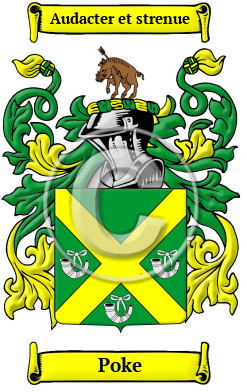
Poke History, Family Crest & Coats of Arms
Etymology of Poke
What does the name Poke mean?
Scottish history reveals Poke was first used as a surname by the Strathclyde-Briton people. It was a name for someone who lived at Pollok (Gaelic: Pollag), a large district on the south-western side of the city of Glasgow, home to Crookston Castle, where Mary, Queen of Scots, was once held. The name of the town has Gaelic origins, from the word ‘poll’, meaning “pool” or “pit”.
Early Origins of the Poke family
The surname Poke was first found in Renfrewshire (Gaelic: Siorrachd Rinn Friù), a historic county of Scotland, today encompassing the Council Areas of Renfrew, East Renfrewshire, and Iverclyde, in the Strathclyde region of southwestern Scotland, where the first occurrence of the name is Peter, son of Fulbert or Fulburt who was granted the lands of Upper Pollock by the High Steward, and who took the surname from the lands, making him the first Pollock. Peter gave the church of Pulloc and its pertinents to the monastery of Paisley, sometime between 1177 and 1199. Within that same period of time, he also confirmed the charter of his brother Helias of Perthic to the same house. Peter also possessed lands in Moray and circa 1175, he witnessed the charter by William the Lion granting Burgin to the Abbey of Kinlos. 1
Circa 1230, Murial de Polloc, a daughter of Peter, gifted her land of Inuerorkel and all its pertinents for the benefit of the hospital erected beside the bridge of Spey for the reception of travelers. Continuing this pattern of generosity, Robert de Pollok granted to the monastery of Paisley, during the reign of Alexander II, alms of twelve pennies a year from the rents he earned from his lands. Other important Pollocks include John Pollok who was both steward of the Abbey of Arbroath and sheriff of Forfar. 1
In England, Pook was a popular variant and in this case, the family was probably from Puckney Gill in the parish of Charlwood, County Surrey, so called from the Old English word “puca” (goblin) and “eg” (island). 2 The surname is first found in Sussex in 1332 as atte Pukenegh, and occurs also in County Surrey at about the same date. From the fourteenth to the seventeenth century the name was largely confined to a small central area of central Sussex, around West Grinstead. The name was also occasionally used as a nickname ‘the puk’ from the complexion of hair or dress, a colour between russet and black. 3
William Puch was documented in the year 1166, and appears to be the first of the name on record. William le Puk of County Somerset, was documented during the reign of Edward III (1327-1377) and John Pouk was recorded in County Somerset at the same time. 4
Early History of the Poke family
This web page shows only a small excerpt of our Poke research. Another 220 words (16 lines of text) covering the years 1234, 1272, 1590, 1603, 1660, 1827 and 1890 are included under the topic Early Poke History in all our PDF Extended History products and printed products wherever possible.
Poke Spelling Variations
It is only in the last few hundred years that rules have developed and the process of spelling according to sound has been abandoned. Scottish names from before that time tend to appear under many different spelling variations. Poke has been spelled Pollock, Pollocke, Polk, Polke, Pollok, Pollick, Polloch, Pook, Pooke, Poock, Pogue, Poag, Poage, Poague, Poak and many more.